Friday, June 5, 2015
A review of Schellenberger's Bettelstudent
The review is anonymous -- from 2013. I am glad I now know who to blame for the wacky costumes. Something in period would surely have been better. What WAS the point of making the leading ladies look like beetles? -- JR
Dagmar Schellenberger must have felt tremendous relief following the premiere of Der Bettelstudent at this year’s Mörbisch Lake Festival. In her first year as the festival’s Intendantin, she was facing more than the usual pressures. Her predecessor was the enormously popular operetta star Harald Serafin, who had been in charge at Mörbisch for two decades, and who had been forced into retirement against his will (presumably because of mandatory age limits). He and his devoted fans were just waiting for Schellenberger to make a misstep.
On top of that, the soprano is a German now at the helm of one of Austria’s most popular summer festivals, and the old rivalries between the two countries still crop up from time to time. In any case, those hoping to see her fall flat on her face must have been sorely disappointed, as this year’s event proved to be a resounding success.
There was marvelous singing from the two tenors Gert Henning Jensen and Mirko Roschkowski as the Polish patriot, Count Opalinski, who had disguised himself as the student Jan Janicki, and his friend, Symon, the beggar student of the title.
With his imposing height and clear, radiant timbre, Jensen was ideal as the youthful adventurer who easily won the heart of Daniela Kalin’s charming Bronislava.
Roschkowski’s warmer, mellower instrument offered the necessary contrast to Jensen’s voice and was well-suited to the daydreamer who finds himself inadvertently caught up in a tangle of events.
Henryk Böhm made the ranting and raving Colonel Ollendorf the comedic center of the show, backed by an attractively singing quintet of his officers and Olaf Plassa as the jailer, Enterich.
Cornelia Zink sang Laura with a glowing, innocent soprano.
On the podium of the festival orchestra, conductor Uwe Theimer supplied plenty of lilting mazurka rhythms in the crowd scenes, but also took the time to highlight the score’s lyrical beauty.
This attention to detail was made possible by the new orchestra hall located behind the seating area, from which their music was fed to the stage area in an arrangement similar to that used at Austria’s other major lake festival at Bregenz.
Director Ralf Nürnberger’s wacky staging was matched by Susanne Thomasberger’s over-the-top costumes with towering wigs and enormous, ballooning hoopskirts.
In contrast, Yadegar Asisi’s unpretentious sets featured a simple city wall that blocked the lake view, and gigantic cabinet-like elements that stage workers opened up to reveal the buildings of Krakow.
Frau Schellenberger’s plans for the 2014 Lake Festival include performances of Anatevka (i.e., Fiddler on the Roof), as well as Mörbisch’s first-ever children’s music theater work composed specifically for the festival, to be performed in the new 300-seat purpose-built facility.
SOURCE

Wednesday, May 27, 2015
Der Bettelstudent

I recently watched the 2013 offering from Moerbisch, "Das größte Operettenfestival der Welt am Neusiedler See im österreichischen Burgenland" set in in Poland of 1704, as the show itself tells us. It was written in 1882. I noted that Moerbisch have their own ballet company, as well as their own choir and orchestra -- up with the NY Met. So they obviously deserve the fulsome description of them that I have just given.
It was a performance of the popular Bettelstudent by Carl Millöcker. It was the first performance at Moerbisch with KS Dagmar Schellenberger as Intendantin.


The show
The performance had a lot in common with Gilbert & Sullivan. About the first third of it was quite madcap. I could have done without the big wigs and absurd gowns on the women but that was of course part of the comic setting. I note that Harald Serafin also put women into wide gowns and absurd wigs on occasions so Schellenberger was within Moerbisch custom in what she did. I thought that it made the women look like beetles but the audience seemed to like it so I concede defeat on that point.
The gowns
The plot was typical operetta nonsense, complete with with deceptions and misunderstandings. There was even TWO purloined letters. No valuable pocket watches this time though. So the plot lived up to expectations -- with some good twists towards the end
And the expected romance was also there -- though only in the second half. And the resolution of all difficulties at the end was also the expected operetta ending, but with a twist. Instead of the lovers getting married, they were already married by that time!
A good show. I see that it has been performed over 5,000 times since 1882.
The singers
I was particularly impressed by the very confident singing of Austrian soprano Cornelia Zink (as Laura) but with her elaborate costume and clownish makeup it was hard to see much of the woman behind the voice. From the closeups of her face that we got, however, one could see that her facial expressions were very fitting. I would have liked her to have got the sort of closeups that Schellenberger got at Moerbisch in 2004. Even in the grotesque deshabille scene one did not get much of an impression of her. So I am putting up a better picture of her below. As I expected, she looks good.
She is a doll! Though she should pay more attention to her roots.
And the lady in the second string story did well too. Daniela Kalin (Bronislava) does not appear to be well-known but somehow transcended her garb and came over as a very attractive lady. We saw quite a lot of her in the deshasbille scene so that would have helped. She reminded me of A.K. Wigger, which is high praise from me. I predict she will go far. Schellenberger obviously knows talent when she sees it (or hears it).
A very romantic show in the end and great fun for that. I was sad that there was no big applause for anyone in particular at the end of the show. I thought Zink deserved more. The Saxon Oberst (Milko Milev) deserved more too. His was an unsympathetic part but he played it very well.
Zink in full voice
With her fake Prince
Some general reflections
After my first watching of the show, for subsequent viewings I did my usual trick of skipping the first few tracks and that got me straight into the interesting bit, which I really enjoyed.
It's not always true but operetta performances often start with boring bits, partly for scene-setting purposes, I guess. The scene of men dressed up as ducks and dogs that introduced the 2004 Moerbisch performance of Graefin Maritza was particularly absurd. I don't know what Harald Serafin had in mind when he put that on but I very nearly stopped watching the show at that point. Maybe I missed a brilliant allegory but there was just no point to it that I could see.
A small absurd touch that I did enjoy in Bettelstudent, I missed the first time around: The fake Prince arrives in a sedan chair to the sound of a steam train! I really like the Moerbisch steam train (Heck! I like ALL steam trains!) so even that allusion to it was pleasing. Congratulations to whoever thought of that absurd idea.
A small thought. The villains in Bettelstudent were Saxons. As Schellenberger is a Saxon, I thought she might have changed that, but perhaps that would have been complicated. And why did they all have red hair? A mark of villainy?
It was interesting that even in 1882 Millöcker was using speech "per du" for comic effect. The whole custom seems needlessly complicated from an Anglo point of view. I presume Millöcker wrote that segment. It could have been a later interpolation, of course.
There was an odd bracket towards the end of the show commenting on the financial crisis among the European banks in 2008+ but one rather wonders why. The only message seemed to be that the little guy gets shafted. That is true but why did it need to be included in this show? If it was meant to be humorous it missed its mark with the audience -- judged by applause.
A very small point that I should probably NOT mention is that the bishop in the wedding procession is emphatically portrayed as shaky -- as having Parkinson's disease, one imagines. As politically incorrect as I am, I can see the funny side of that but many would not. Though respect for the clergy is very low in Western Europe generally these days so maybe the clergy could not complain. They have brought disrespect down on their own heads with various scandals.
Sunday, May 10, 2015
Saturday, April 11, 2015
Die lustige Witwe
I suppose I am a bit foolish to bother about these things but I have myself done a fair bit of translation from German so I am inclined to make a few comments about the translation of Die lustige Witwe. The usual translation is "The merry widow" and I suppose that is close enough but "gay" or "pleasure-seeking" would approximate it too. "Lustig" is not "lusty", however. It is about having a good or entertaining time.
I was delighted recently to receive a DVD of the operetta by Lehar of that name which featured Dagmar Schellenberger as the leading lady. After her performance as Mariza at Moerbisch I expected some brilliant singing and acting and I was not disappointed.
The performance was from Zuerich in der Schweiz, in the Zurich opera house -- and that made clear to me how Moerbisch spoils us. The high tech facilities at Moerbisch enable lots of very sharp and very close close-ups -- rather like in a Hollywood musical. So facial expressions can be seen in great detail. The technicians at Zurich were no slouch but broadcasting from an ordinary opera house did limit them, with the lighting apparently being the main culprit.
So the brilliant expressions that Schellenberger is known for were at their clearest only when she was under bright light. Lighting varies in opera houses so clarity was on other occasions reduced. There was not the constant clarity to be found at Moerbisch. What was particularly missing was Schellenberger's eyes. She has the most expressive eyes and one could not always see them at critical junctures. We saw enough of her, however, to marvel yet again at how well her face mirrored what was going on. She has the most amazing range of expressions -- and all used appropriately to the story. I liked it when she answered her difficult man with just one glance of her eyes.
And it's not only facial expressions. Her gestures and body language are eloquent too. Her body language when she was urging the dummer Reitersmann to claim her was a legend-quality example of non-verbally saying "take me".
And the very different role did call forth from Schellenberger a new lot of expressions. This time she brilliantly conveyed disgust, pique and coquettishness -- among much else. Her singing was as good as ever but the role did not really stretch her -- though she did belt out a few high notes for fun on occasions.
But it was a fun operetta and I will be watching it repeatedly. It gains with each successive viewing of course. The local patrons at the Teatro alla scala in Milano know that. They normally know well the opera put on there but keep going along to absorb more of it.
I initially thought that Schellenberger looked younger than she was at Moerbisch but, on checking, I found that both performances were in 2004! It shows how much difference hair, makeup and clothes can make. And her role was quite different too. At Moerbisch she was the haughty lady who fell in love against her better judgement whereas at Zurich she was the pretty and clever little lady who was determined to get her man. And, this being operetta, she did, of course. The man didn't have a hope. Whether she IS the ultimate female or not, she certainly plays one with great conviction.
The Swiss were a bit more daring in the costume department too. Both Schellenberger and Ute Gfrerer showed noticeable cleavage, particularly so in the case of Gfrerer. Gfrerer was the second lead, playing Valencienne, the attractive young singer married to a rich older man.
Gfrerer seems to be a rather jolly lady in general but her part in this show was almost wholly serious. She was even asked, rather absurdly for her, to be Eine anstaendige Frau (a respectable wife). I was inclined to think that her notable bosom was what got her the part and that may have been so. It did suit the role. But she is also much acclaimed as a singer and actress. There is a bio of her here.
Her natural talent for gaiety did however surface in the dancing. She was in any dancing going, whether the part really called for it or not. She even led the cabaret dancers towards the end of the show. With big smiles and shrieks, her happiness throughout the dancing was a joy to watch. She even got herself tipped upside down in that last segment! She is a naturally happy lady, I think. And being born both beautiful and talented why should she not be happy?
 Ute Gfrerer
Schellenberger with the ambassador

Schellenberger with her "difficult" man
In fact Zurich got top talent all round. Even the conductor has a distinguished record. He was Franz Welser-Moest and when I saw him I thought he was rather young as conductors go -- but I was mistaken. He was in fact 44 at the time. A lot of German men are ageless for a long time and he is obviously one of those. Something to do with the climate, maybe. I was at a conference at Oxford once when I saw a New York lady mistake a good-looking German man as being about 30. He was closer to 50.
The music was of course good so it seems a pity that none of the arias seem to be much used outside the context of the operetta itself. Some of the tunes might even reasonably be described as catchy. Vilja gets a very occasional airing as a concert piece by itself but even on YouTube most of the renditions are extracted from stage performances of the operetta.
The inescapable Andre Rieu has of course grabbed it for his shows and in fact done rather well with it. He has up a very sweet rendition by a slightly built black South African soprano named Kimmy Skota. She does not of course have a fraction of Schellenberger's facial expressions but the singing is as good as any. I find it hard to evaluate Schellenberger's performance of the aria as just singing. I can't isolate the singing from the brilliant way she plays the part as a whole.
I was amused that "men" are described in one of the later scenes as quoting Heinrich Heine (a German romantic poet) to win women. I like some of Heine but have never recited Heine to a woman I was interested in -- but I did once quote Goethe to a very fine woman with good effect. I am out of contact with her now, to my regret, but I imagine she still remembers that too: "Tiefe Stille herrscht im Wasser ...". I have had some lovely ladies in my life and I fear that I did not treat them all as well as they deserved.
The stars of the show were undoubtedly the two ladies above but Njegus the majordomo was a great comic touch too. And Rudolf Hartmann made a great comic figure out of Baron Zeta.
And I must of course say something about the big and mellifluous American baritone, Rodney Gilfry, who has learnt enough Hoch Deutsch to play Graf Danilo well. His rugged good looks do make him credible in the part as much admired by women but he is quite powerless against the the German ultra feminine Schellenberger. Schellenberger has been described as "Prussian energy plus feminine charm" -- and there is a lot to that. A real-life man could not withstand her for 5 minutes.
A small point: My old ears are not so good these days but, as I hear it, Schellenberger does reply to her lover on some occasions with the Slavic "da" rather than the German "ja". That would be in keeping but I do wonder if my ears deceive me.
And the two little voiceless sobs she does in the humming song are immensely evocative, though I do think they are a bit of a trademark for her. She is one clever lady.
A small language note: The honorific Russian form of address "Gospodin"/"Gospodina" is used on occasions in the show -- presumably to identify the mythical country in which the show is set as Slavic (clearly modelled on Montenegro). It means "Your honour" or "Gracious lady" or something along those lines. It is perhaps a bit less empty than the German expression "Gnaedige Frau" (which is also used).
Speaking of expressions, it is mildly interesting that women in German lands rarely refer to their husband as a husband. They refer to him as "mein Mann" (my man). There is a German word for husband (Ehemann) but it seems to be little used. And Frau (woman) is also used to mean "wife".
Another language note: As the anstaendige Frau is a recurrent theme, I thought I should elaborate a little on the meaning of anstaendig. It is reasonably translated as "respectable" but it is also often translated as "decent". It is a claim about her good character as well as a claim about her good reputation. On one occasion she describes herself in French as a femme d' honneur and I think that best captures what is intended for the part. It means a "woman of honor". Interesting that the old Latin word honor is still used in both English and French with the same, original meaning. I am mildly regretful that the Old English word mensk has been completely supplanted by it.
I was a bit peeved that the French used in the show was subtitled but not translated. I haven't spent one minute studying French. But, fortunately, my general knowledge of European languages enabled me to get most of it.
Finally, is there a political message in the operetta? Patriotism is rather clearly held up to ridicule in it but is Lehar ridiculing Austro/Hungarian patriotism, the patriotism of small countries or ridiculing patriotism generally? I will have to read further on that, I think. He was not himself Jewish but his wife was and he associated a lot with Jews so that may have made him skeptical of the patriotic sentiments of the time. On the other hand he spent a lot of his early life in the armed forces, which usually encourages patriotism. On balance, I am inclined to suspect that he saw Austro/Hungarian patriotism as excessive. His near contemporary in England, W.S. Gilbert (in the Gilbert & Sullivan light operas) was certainly no respecter of the establishment.
Wednesday, April 8, 2015
A few more notes on Graefin Mariza
I am at the moment "nuts" about the 2004 performance at Moerbisch of Kalman's Graefin Mariza. I have already written a bit about it but I think I should add a few things that might, via the magic of Google, be helpful to people looking for more information about it. There is very little available in English about it online so far.
I think I have watched the show every night since I got the DVD some weeks ago. It is to me great entertainment and also a perfect work of art. I even still laugh at jokes that I have heard around 30 times already! The combination of Kalman's music and the no-expenses-spared staging at Moerbisch is hard to beat. I love the Moerbisch steam train.
And, in the usual way for operettas, the show is exceedingly romantic. Love is its theme. So why the Devil do I enjoy it? I see myself as one of the world's least romantic persons. But as the ancient Greeks used to say, "It's a wise man who knows himself" and the fact that I have been married four times may be some evidence of that. And I still think that I married four very fine ladies.
Moerbisch is such a prestigious venue in the world of operetta that the organizers must have had just about untrammeled choice among all the many singers of the German lands. Germans did terrible things to themselves (and others) in two world wars but artistic talent still abounds there. So the directors at Moerbisch could demand performers who were both brilliant singers and great actors -- and pretty good dancers too. And in 2004 they got all that.
And Dagmar Schellenberger as Mariza was the first among greats. Her brilliant acting and rich soprano voice rather mesmerize me. Her acting would be taken as over-acting at Hollywood but it was perfect for operetta, where realism is secondary to a great show. I enjoy her amazingly expressive acting as much as her faultless singing. She must have the most expressive eyes I have ever seen. Her facial and bodily expressions are perfect for every moment of the story and convey almost as much as her singing. She does hauteur, anger and ecstasy equally briliantly.
And I loved the comic performance by Marco Kathol as Baron Zsupan almost as much. He is a very good tenor who, unusually, was also a ballet dancer for some years. And his dancing background shows. His moves are so fleet and flexible that they are a wonder to watch. He must have been a pretty good ballet dancer too. He is a pleasure to watch.
And he is obviously still very strong and fit. He picks up Schellenberger as easily as if she were one of the wispy little ladies of ballet. And Schellenberger looked to be a fine figure of a woman, almost a "big bizzem", as they say in Scotland. When the character Penizek in the show checks out her "architecture" he had reason to be pleased with what he saw. For most of the show she wears heavily "glammed up" clothes that rather disguise her body but when she gets into her milkmaid Tracht towards the end of the show she looks very good indeed.
In another operetta, Die lustige Witwe, we find the meaning of "architecture" spelled out a little more -- as a good mezzanine and a good balcony. I think we get the drift.
All of the singers in the show performed their roles very well but it is Schellenberger and Kathol who cause me to watch it again and again. After watching the show many times I now laugh the minute I see Kathol roll onto the stage on his railway handcar.
The producers of the show never resolved the conflict between representing the period of the show as either the 1920s when it was written or the late 19th century in which it is set. There were also a few references to modern times, but mainly for humorous effect. I was rather pleased that a passing reference to the EU got a big laugh. It is a bureaucratic monster that needs to be laughed at.
And if you do know a bit of history some strange things happen. When Mariza asks Herr Toerek, "Haben Sie einen Frack" he replies affirmatively. But nobody in the show at any time wears a late 19th century Frack. A late 19th century Frack was what was known in English as a frock coat, a long coat that belled out slightly towards the bottom. It was not cutaway. You occasionally see them on gamblers and the like in cowboy movies. In Graefin Mariza formal dress is the more modern Frack of the 1920s, a tailcoat. The producers of the show kept the original words but not the period dress. The subtitle translators rendered Frack as "dress-shirt", which is simply wrong. "Evening clothes" would have been better.
The best song of the show is undoubtedly the Varazdin song. It is very catchy. But until you try to sing it you don't realize that it is a tongue-twister too. Kathol and Schellenberger to well to gallop energetically through it. When I try to sing along I can't do it. I always stumble over Gulaschsaft (goulash juice). The words are below:
Komm mit nach Varazdin! So lange noch die Rosen blüh'n,
Dort woll'n wir glücklich sein, wir beide ganz allein!
Du bist die schönste Fee, von Debrecen bis Plattensee,
Drum möcht mit dir ich hin nach Varazdin!
Denn meine Leidenschaft, brennt heisser noch als Gulaschsaft
Und in der Brust tanzt Herz mir Czardas her und hin!
Komm mit nach Varazdin, so lange noch die Rosen blüh'n,
Dort ist die ganze Welt noch rot, weiss, grün!
The "rot, weiss, grün" (red white and green) refers to the colours of the Hungarian flag. The operetta is set in a grand Hungarian estate.
And I should say something about the Puszta. It is mentioned quite a lot both at the beginning and the end of the show. In the subtitles, it is sometimes translated (as "prairie") and sometimes not. As Wikipedia informatively says: "The Hungarian puszta is an exclave of the Eurasian Steppe". It is a large area mostly of grassland with rather infertile soils -- but the interesting part is the people who live there. Wikipedia doesn't tell you about that. It's a hard life there and it breeds a tough people. And it is the women of the Puszta who are idolized in Graefin Mariza. They are seen as particularly lively and attractive -- and, one suspects, rather easily seduced by rich Hungarian men.
Hungary generally is in fact greatly romanticized by Kalman. And not only mainstream Hungarian society but also the Hungarian gypsies are extolled. Gypsy music is in fact to a large degree the focus of the show. But gypsy fortunetelling is treated with respect, as are gypsy dancers. Why was Kalman so enthused by gypsies? It's got to have something to do with the fact that Kalman was a Hungarian Jew (born Imre Koppstein). Antisemitism was already rife in Vienna and elsewhere when Kalman was writing -- Nazism arose in fertile soil -- and it must have freaked him. So was he trying to claim a new identity for himself? Perhaps.
There is a lot to note about the language in the show. It took me a while to figure out what was going on when the word Zigan was used. When sung, it sounded like Sieger (victor) to me but I eventually figured out that it was just an abbreviation for Zigeuner (gypsy).
And a curiosity about the language was a roughly 50/50 split over where the emphasis should be placed on Mariza. Is it MAHriza or MahRITza? Schellenberger pronounces it the latter way but others do not. So either way is "correct".
There is quite a lot of wordplay in the show but you miss most of it unless you know some German. One thing that struck me as odd was when the majordomo opined that Bela Toerek was named "Bela" because he was good looking -- an allusion to the Italian "bella", meaning beautiful. But Bela is a common Hungarian Christian name and Hungarian is unrelated to other European languages so how could he think that? Apparently there is no agreed meaning for the name "Bela" so he was at liberty to make a romantic speculation about it.
And the split between Northern and Southern German pronuciation is referred to. Northern Germans tend to look down on Southern Germans but Southerners don't give a damn about that. And Fuerstin Cuddenstein, the rich aunt, is portrayed as speaking in a broad Southern way. Like the Swiss, she says "Daitsch" instead of "Deutsch". So she brings her German teacher, a former thespian, with her to "improve" her speech.
The translators do a manful job of turning German into English but the translations are quite "free" (non-literal). I don't underestimate their difficulties, though. German and English were the same language 1500 years ago but a lot has changed since then. And the two languages do to an extent cut up reality in different ways these days. I have made a few notes about that from my days translating the German of Karl Marx and Adolf Hitler into English. A lot of what those two gentlemen said during their lives poses difficulties for the modern political Left so had not been available in translated form online. So it was amusing for me to let the cat out of the bag.
So all that adds up to the fact that you get a lot more out of the show to the extent that you understand German. Translations just cannot do the whole job of conveying the original intention of the text. One instance of that occurs when the Graefin is declaring her intention to stay on her Gut (estate). To deter any opposition to her decision,she adds, "sicher und sicher". That is certainly very emphatic in German and Schellenberger's facial expression says more than words probably could anyway. But sicher literally means firm or secure so you cannot translate it well directly. You have to use a circumlocution. And no circumlocution that I can think of is as emphatic. So I hope that my various comments here about things in the show will help to a small degree to make up for any lack of German in those who view it.

With her aging admirer
I am at the moment "nuts" about the 2004 performance at Moerbisch of Kalman's Graefin Mariza. I have already written a bit about it but I think I should add a few things that might, via the magic of Google, be helpful to people looking for more information about it. There is very little available in English about it online so far.
I think I have watched the show every night since I got the DVD some weeks ago. It is to me great entertainment and also a perfect work of art. I even still laugh at jokes that I have heard around 30 times already! The combination of Kalman's music and the no-expenses-spared staging at Moerbisch is hard to beat. I love the Moerbisch steam train.
And, in the usual way for operettas, the show is exceedingly romantic. Love is its theme. So why the Devil do I enjoy it? I see myself as one of the world's least romantic persons. But as the ancient Greeks used to say, "It's a wise man who knows himself" and the fact that I have been married four times may be some evidence of that. And I still think that I married four very fine ladies.
Moerbisch is such a prestigious venue in the world of operetta that the organizers must have had just about untrammeled choice among all the many singers of the German lands. Germans did terrible things to themselves (and others) in two world wars but artistic talent still abounds there. So the directors at Moerbisch could demand performers who were both brilliant singers and great actors -- and pretty good dancers too. And in 2004 they got all that.
And Dagmar Schellenberger as Mariza was the first among greats. Her brilliant acting and rich soprano voice rather mesmerize me. Her acting would be taken as over-acting at Hollywood but it was perfect for operetta, where realism is secondary to a great show. I enjoy her amazingly expressive acting as much as her faultless singing. She must have the most expressive eyes I have ever seen. Her facial and bodily expressions are perfect for every moment of the story and convey almost as much as her singing. She does hauteur, anger and ecstasy equally briliantly.
And I loved the comic performance by Marco Kathol as Baron Zsupan almost as much. He is a very good tenor who, unusually, was also a ballet dancer for some years. And his dancing background shows. His moves are so fleet and flexible that they are a wonder to watch. He must have been a pretty good ballet dancer too. He is a pleasure to watch.
And he is obviously still very strong and fit. He picks up Schellenberger as easily as if she were one of the wispy little ladies of ballet. And Schellenberger looked to be a fine figure of a woman, almost a "big bizzem", as they say in Scotland. When the character Penizek in the show checks out her "architecture" he had reason to be pleased with what he saw. For most of the show she wears heavily "glammed up" clothes that rather disguise her body but when she gets into her milkmaid Tracht towards the end of the show she looks very good indeed.
In another operetta, Die lustige Witwe, we find the meaning of "architecture" spelled out a little more -- as a good mezzanine and a good balcony. I think we get the drift.
All of the singers in the show performed their roles very well but it is Schellenberger and Kathol who cause me to watch it again and again. After watching the show many times I now laugh the minute I see Kathol roll onto the stage on his railway handcar.
The producers of the show never resolved the conflict between representing the period of the show as either the 1920s when it was written or the late 19th century in which it is set. There were also a few references to modern times, but mainly for humorous effect. I was rather pleased that a passing reference to the EU got a big laugh. It is a bureaucratic monster that needs to be laughed at.
And if you do know a bit of history some strange things happen. When Mariza asks Herr Toerek, "Haben Sie einen Frack" he replies affirmatively. But nobody in the show at any time wears a late 19th century Frack. A late 19th century Frack was what was known in English as a frock coat, a long coat that belled out slightly towards the bottom. It was not cutaway. You occasionally see them on gamblers and the like in cowboy movies. In Graefin Mariza formal dress is the more modern Frack of the 1920s, a tailcoat. The producers of the show kept the original words but not the period dress. The subtitle translators rendered Frack as "dress-shirt", which is simply wrong. "Evening clothes" would have been better.
The best song of the show is undoubtedly the Varazdin song. It is very catchy. But until you try to sing it you don't realize that it is a tongue-twister too. Kathol and Schellenberger to well to gallop energetically through it. When I try to sing along I can't do it. I always stumble over Gulaschsaft (goulash juice). The words are below:
Komm mit nach Varazdin! So lange noch die Rosen blüh'n,
Dort woll'n wir glücklich sein, wir beide ganz allein!
Du bist die schönste Fee, von Debrecen bis Plattensee,
Drum möcht mit dir ich hin nach Varazdin!
Denn meine Leidenschaft, brennt heisser noch als Gulaschsaft
Und in der Brust tanzt Herz mir Czardas her und hin!
Komm mit nach Varazdin, so lange noch die Rosen blüh'n,
Dort ist die ganze Welt noch rot, weiss, grün!
The "rot, weiss, grün" (red white and green) refers to the colours of the Hungarian flag. The operetta is set in a grand Hungarian estate.
And I should say something about the Puszta. It is mentioned quite a lot both at the beginning and the end of the show. In the subtitles, it is sometimes translated (as "prairie") and sometimes not. As Wikipedia informatively says: "The Hungarian puszta is an exclave of the Eurasian Steppe". It is a large area mostly of grassland with rather infertile soils -- but the interesting part is the people who live there. Wikipedia doesn't tell you about that. It's a hard life there and it breeds a tough people. And it is the women of the Puszta who are idolized in Graefin Mariza. They are seen as particularly lively and attractive -- and, one suspects, rather easily seduced by rich Hungarian men.
Hungary generally is in fact greatly romanticized by Kalman. And not only mainstream Hungarian society but also the Hungarian gypsies are extolled. Gypsy music is in fact to a large degree the focus of the show. But gypsy fortunetelling is treated with respect, as are gypsy dancers. Why was Kalman so enthused by gypsies? It's got to have something to do with the fact that Kalman was a Hungarian Jew (born Imre Koppstein). Antisemitism was already rife in Vienna and elsewhere when Kalman was writing -- Nazism arose in fertile soil -- and it must have freaked him. So was he trying to claim a new identity for himself? Perhaps.
There is a lot to note about the language in the show. It took me a while to figure out what was going on when the word Zigan was used. When sung, it sounded like Sieger (victor) to me but I eventually figured out that it was just an abbreviation for Zigeuner (gypsy).
And a curiosity about the language was a roughly 50/50 split over where the emphasis should be placed on Mariza. Is it MAHriza or MahRITza? Schellenberger pronounces it the latter way but others do not. So either way is "correct".
There is quite a lot of wordplay in the show but you miss most of it unless you know some German. One thing that struck me as odd was when the majordomo opined that Bela Toerek was named "Bela" because he was good looking -- an allusion to the Italian "bella", meaning beautiful. But Bela is a common Hungarian Christian name and Hungarian is unrelated to other European languages so how could he think that? Apparently there is no agreed meaning for the name "Bela" so he was at liberty to make a romantic speculation about it.
And the split between Northern and Southern German pronuciation is referred to. Northern Germans tend to look down on Southern Germans but Southerners don't give a damn about that. And Fuerstin Cuddenstein, the rich aunt, is portrayed as speaking in a broad Southern way. Like the Swiss, she says "Daitsch" instead of "Deutsch". So she brings her German teacher, a former thespian, with her to "improve" her speech.
The translators do a manful job of turning German into English but the translations are quite "free" (non-literal). I don't underestimate their difficulties, though. German and English were the same language 1500 years ago but a lot has changed since then. And the two languages do to an extent cut up reality in different ways these days. I have made a few notes about that from my days translating the German of Karl Marx and Adolf Hitler into English. A lot of what those two gentlemen said during their lives poses difficulties for the modern political Left so had not been available in translated form online. So it was amusing for me to let the cat out of the bag.
So all that adds up to the fact that you get a lot more out of the show to the extent that you understand German. Translations just cannot do the whole job of conveying the original intention of the text. One instance of that occurs when the Graefin is declaring her intention to stay on her Gut (estate). To deter any opposition to her decision,she adds, "sicher und sicher". That is certainly very emphatic in German and Schellenberger's facial expression says more than words probably could anyway. But sicher literally means firm or secure so you cannot translate it well directly. You have to use a circumlocution. And no circumlocution that I can think of is as emphatic. So I hope that my various comments here about things in the show will help to a small degree to make up for any lack of German in those who view it.
With her aging admirer
Friday, March 27, 2015
Emerich (Imre) Kalman
Who the Devil is Emerich Kalman? His name goes close to being totally forgotten these days but in the first half of the 20th century he was much acclaimed. His music was so popular that Hitler even offered to make him an honorary Aryan (Kalman was Jewish) -- an amazing distinction, whatever else it was. Kalman declined the offer and got out of Europe while the going was good.
But there is one place these days where he has not been forgotten: Moerbisch. Moerbisch is as near as you can get to being the world headquarters of operetta. Situated by a lake in Austria's beautiful Salzkammergut (Lake District), Moerbisch is to operetta as Bayreuth is to Wagner. Performances at Moerbisch are lavish. Huge sums are spent on them to make them as good a performance of the work concerned as you can possibly get.
And the audience at Moerbisch is amazing in its vastness. When the cameras cut to the audience you can see that their claim of huge audiences is fully believable. The audience goes on forever. It looks like half of Vienna is there. Does any other stage performance have an audience that big? I know of none. Perhaps in Russia.
The Moerbisch performances might almost be called "definitive" performances except for one thing: No two stage shows of any kind are ever the same (except perhaps for Shakespearean performances). The original script is taken as not much more than a set of suggestions in many cases. The producer on each occasion feels free to cut bits out and put new bits in. And for the light entertainment that is operetta that is particularly so.
That seems to me disrespectful of the talent that made the show notable in the first place but it can help by making a show more relevant to a particular time and place. And the great resources of all kinds now available in the early 21st century greatly expand what can be done -- things that would probably not be dreamed of by the original author -- but which do expand the watchability and impact of the show.
And having the great resources of Moerbisch applied to an operetta by Hungarian composer Kalman certainly produces very good musical theatre indeed. I have recently watch the 2004 Moerbisch performance of Kalman's Graefin Maritza and was quite gripped by it. The plot of the play is the sort of folly you expect from operetta -- with everybody living happily ever after by the end of the show -- but the acting and the singing were as good as can be.
And Kalman's music was both lively and inclusive of some very catchy songs. I am in fact rather amazed that the Varasdin song is not better known. It is very fun and catchy indeed. The inhabitants of the fine city of Varasdin in Northern Croatia are probably not too keen on the song as it portrays Varasdin as home to 18,000 pigs -- when Varasdin has much grander real claims than that.
Tenor Marko Kathol leads the Varasdin scene and I was much impressed by his talent. I have watched that scene over and over again. With Kalman's music and the spirited performances by both Kathol and the "Graefin" (Dagmar Schellenberger), it is so beautiful that it tends to make me weep at times (Even when sober!). I have looked Kathol up and it seems that others share my very favourable impression of his abilities. That he is a former ballet dancer certainly shows in the flexibility with which he moves
Viennese operetta has a sort of frantic gaiety about it. It came into its own in the aftermath of the ghastly WWI and no city was more impacted by that war than Vienna. It lost something like 90% of the territory it once ruled. But, being the city of music, Vienna rose to the occasion and produced entertainment that both lightened the spirits and took people back to happier days. The operettas are most set in the prewar period. They have left a great musical treasure for us all.
You can view the whole Moerbisch performance of Graefin Maritza online here. But if you want English subtitles you will have to buy the DVD. The words are of course in German, but the music is international. Go to the 48 minute mark for the marvellous Varasdin song ("Komm mit nach Varasdin"). The words of the song are here
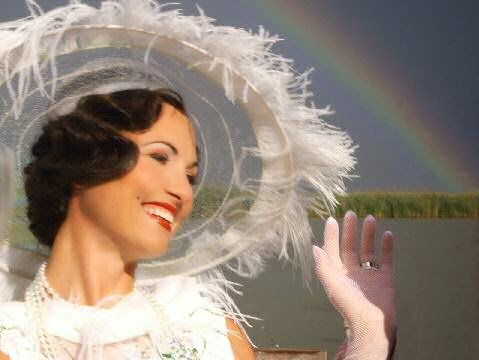
There is a nice picture below of the very expressive Dagmar Schellenberger in her role as the Graefin at Moerbisch in 2004. She is both a most accomplished soprano and a superb actress.
Who the Devil is Emerich Kalman? His name goes close to being totally forgotten these days but in the first half of the 20th century he was much acclaimed. His music was so popular that Hitler even offered to make him an honorary Aryan (Kalman was Jewish) -- an amazing distinction, whatever else it was. Kalman declined the offer and got out of Europe while the going was good.
But there is one place these days where he has not been forgotten: Moerbisch. Moerbisch is as near as you can get to being the world headquarters of operetta. Situated by a lake in Austria's beautiful Salzkammergut (Lake District), Moerbisch is to operetta as Bayreuth is to Wagner. Performances at Moerbisch are lavish. Huge sums are spent on them to make them as good a performance of the work concerned as you can possibly get.
And the audience at Moerbisch is amazing in its vastness. When the cameras cut to the audience you can see that their claim of huge audiences is fully believable. The audience goes on forever. It looks like half of Vienna is there. Does any other stage performance have an audience that big? I know of none. Perhaps in Russia.
The Moerbisch performances might almost be called "definitive" performances except for one thing: No two stage shows of any kind are ever the same (except perhaps for Shakespearean performances). The original script is taken as not much more than a set of suggestions in many cases. The producer on each occasion feels free to cut bits out and put new bits in. And for the light entertainment that is operetta that is particularly so.
That seems to me disrespectful of the talent that made the show notable in the first place but it can help by making a show more relevant to a particular time and place. And the great resources of all kinds now available in the early 21st century greatly expand what can be done -- things that would probably not be dreamed of by the original author -- but which do expand the watchability and impact of the show.
And having the great resources of Moerbisch applied to an operetta by Hungarian composer Kalman certainly produces very good musical theatre indeed. I have recently watch the 2004 Moerbisch performance of Kalman's Graefin Maritza and was quite gripped by it. The plot of the play is the sort of folly you expect from operetta -- with everybody living happily ever after by the end of the show -- but the acting and the singing were as good as can be.
And Kalman's music was both lively and inclusive of some very catchy songs. I am in fact rather amazed that the Varasdin song is not better known. It is very fun and catchy indeed. The inhabitants of the fine city of Varasdin in Northern Croatia are probably not too keen on the song as it portrays Varasdin as home to 18,000 pigs -- when Varasdin has much grander real claims than that.
Tenor Marko Kathol leads the Varasdin scene and I was much impressed by his talent. I have watched that scene over and over again. With Kalman's music and the spirited performances by both Kathol and the "Graefin" (Dagmar Schellenberger), it is so beautiful that it tends to make me weep at times (Even when sober!). I have looked Kathol up and it seems that others share my very favourable impression of his abilities. That he is a former ballet dancer certainly shows in the flexibility with which he moves
Viennese operetta has a sort of frantic gaiety about it. It came into its own in the aftermath of the ghastly WWI and no city was more impacted by that war than Vienna. It lost something like 90% of the territory it once ruled. But, being the city of music, Vienna rose to the occasion and produced entertainment that both lightened the spirits and took people back to happier days. The operettas are most set in the prewar period. They have left a great musical treasure for us all.
You can view the whole Moerbisch performance of Graefin Maritza online here. But if you want English subtitles you will have to buy the DVD. The words are of course in German, but the music is international. Go to the 48 minute mark for the marvellous Varasdin song ("Komm mit nach Varasdin"). The words of the song are here
There is a nice picture below of the very expressive Dagmar Schellenberger in her role as the Graefin at Moerbisch in 2004. She is both a most accomplished soprano and a superb actress.
Tuesday, March 10, 2015
Libretto for: "Komm mit nach Varazdin" episode (Gräfin Mariza)
ER Ich bitte, nicht lachen, der Ise , der Sachen, der Amor, Der hat mich so gepackt! Die Urkraft der Triebe, das Feuer der Liebe, Ich weiss nicht genau wie man da sagt!
SIE Ich find'es ergötzlich,dass sie gar so plötzlich, So stürmisch ihr Herz für mich entdeckt, Sie sparten, mit Worten nicht, mit zarten, Doch müssen sie noch warten, sie haben mich erschreckt!
ER Das geht nicht! Ich dichte nicht, ich red'nicht, Ich bin auch kein Poet nicht, ich sage nur:
Komm mit nach Varazdin! So lange noch die Rosen blüh'n, Dort woll'n wir glücklich sein, wir beide ganz allein! Du bist die schönste Fee, von Debrecen bis Plattensee, Drum möcht mit dir ich hin nach Varazdin! Denn meine Leidenschaft, brennt heisser noch als Gulaschsaft Und in der Brust tanzt Herz mir Czardas her und hin! Komm mit nach Varazdin, so lange noch die Rosen blüh'n, Dort ist die ganze Welt noch rot , weiss ,grün!
SIE Da kann man nix machen, der Ise, der Sachen, der Amor, Der ist schon einmal so!
ER Der Spitzbub erst spielt er, dann lacht er, dann zielt er, Dann schiesst er und trifft uns irgendwo!
SIE Sie sprechen sehr drastisch, sie schildren sehr plastisch, Sie schneiden ganz reizend mir die Cour, Ein Freier mit Temprament und Feuer wie sie,wirkt ungeheuer Auf's Herz und pour l'amour!
ER Ja! wenn ich sie anschau nur, so brenn'ich und brenn'ich, Hat, so kenn'ich das Eine nur:
Komm mit nach Varazdin! So lange noch die Rosen blüh'n, Dort woll'n wir glücklich sein, wir beide ganz allein! Du bist die schönste Fee, von Debrecen bis Plattensee, Drum möcht mit dir ich hin nach Varazdin! Denn meine Leidenschaft, brennt heisser noch als Gulaschsaft Und in der Brust tanzt Herz mir Czardas her und hin! Komm mit nach Varazdin, so lange noch die Rosen blüh'n, Dort ist die ganze Welt noch rot , weiss ,grün!
Subscribe to:
Comments (Atom)


